
FIELD NOTE
This is a field note from inside my reality. I am not writing a universal map for everyone else to obey. I am documenting my truth, examining the patterns I see, and following them toward the ecosystem I am trying to build.
Darkstar Multimedia: The Ecosystem as Living Technology
When I examine the systems surrounding us, I keep finding the same design failure: they were built around an imaginary standard person and then taught everyone outside that standard to experience exclusion as a personal defect.
I do not accept that diagnosis of the problem. If a system repeatedly excludes disabled people, neurodivergent people, poor people, veterans, independent creators, and anyone who cannot remain constantly available, then the people are not the malfunction. The architecture is.
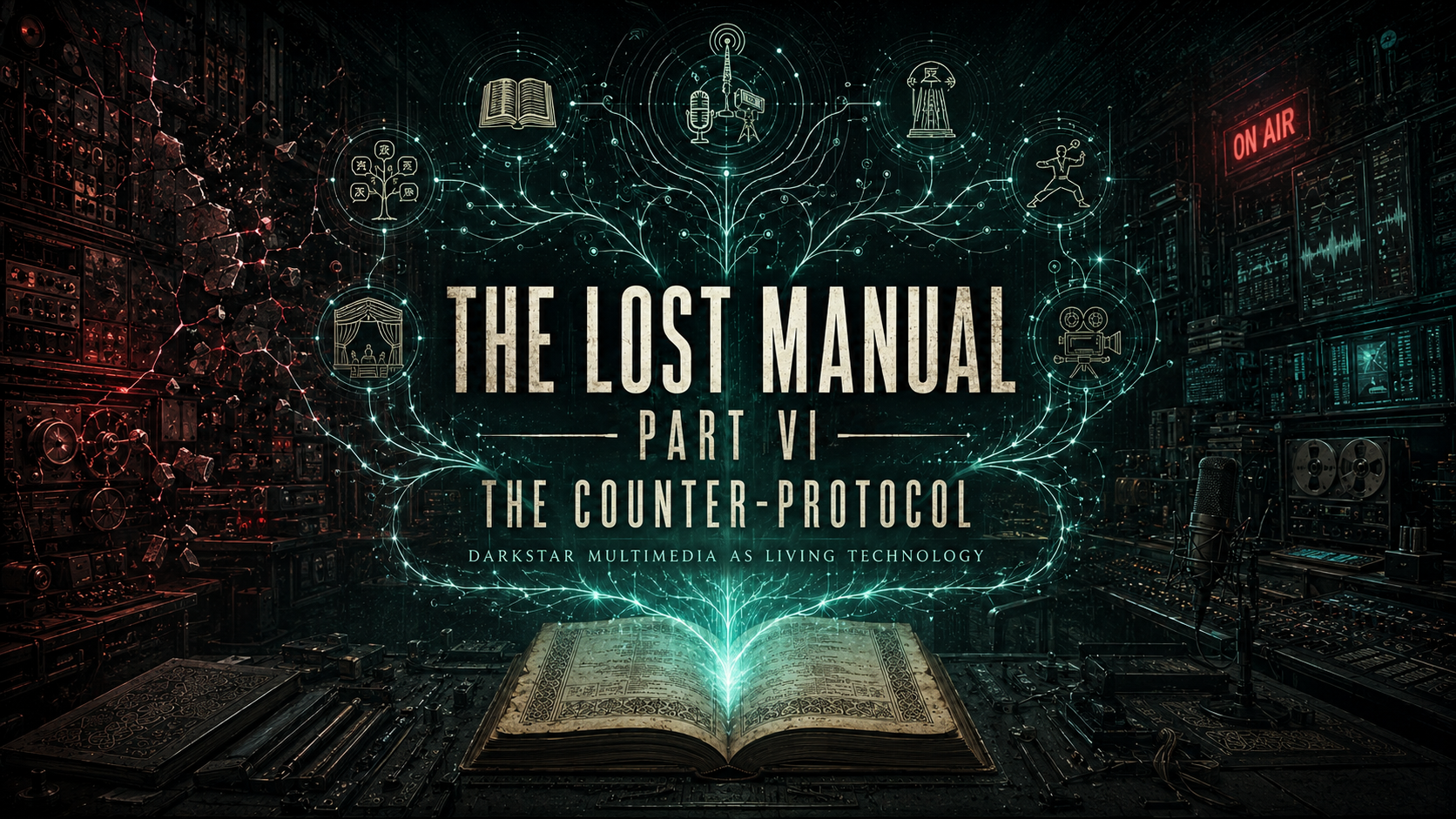
Darkstar Multimedia is my attempt to build a counter-protocol: not one giant platform pretending to solve everything, but an ecosystem of connected spaces where different forms of participation can support one another.
If the gods are technology, then the future I am building cannot remain symbolic. It has to become platforms, studios, schools, commons, theatres, broadcasts, publications, virtual spaces, communication systems, and physical gathering places where people can actually live differently.
Darkstar Multimedia is the larger ecosystem holding that work together: a connected network of tools, communities, creative studios, research spaces, and experiences designed around access, belonging, and participation.
When I examine the barriers people keep being told to accept, each concept answers a different one:
- inaccessible entertainment and storytelling
- fragmented and overwhelming online communities
- lack of adaptive training and movement spaces
- limited creator discovery and ethical publishing pathways
- barriers to virtual production, independent broadcasting, and collaborative theatre
- the absence of community-built technology designed around lived experience
The shared purpose is the same: to create systems where people can participate, contribute, connect, and be recognized without conforming to environments that were never designed for them.
The Hive: Memory With Consent
The Hive is the communication framework inside this ecosystem. It is not meant to become another overwhelming social-media destination. Each community can have its own Hive space shaped around its own needs: a dojo using it for classes and student support, a writing community using it for workshops and critique, a theatre group using it for rehearsal, or a production studio using it for planning, interviews, and collaborative work. The long-term vision is simple and radical: people should not have to be constantly available in order to belong.
Built-in AI context tools could help people understand what happened, what was decided, what remains open, what needs attention, and how to participate without endless scrolling or notification overload. Community owners decide whether spoken rooms, meetings, voice chats, text chats, or project spaces are recorded and summarized for returning members. That consent choice controls memory and recap, not safety: security monitoring remains on to detect abuse, harassment, threats, bullying, stalking, dogpiling, sexual content, grooming behavior, NSFW material, and other harmful patterns in real time. When summaries are enabled, a person can step away, come back later, and receive a clear account of what they missed instead of being punished by the pace of the room. The Hive is memory with consent, security without surrender, context without overwhelm, and return without punishment.
- Optional recap memory: community owners decide whether spoken rooms, meetings, voice chats, text chats, or project spaces are recorded and summarized.
- Always-on safety monitoring: security stays active to detect abuse, harassment, threats, bullying, stalking, dogpiling, and harmful patterns in real time.
- Return without punishment: when summaries are enabled, members can step away and come back to a clear account of what they missed.
- Consent visibility: users should know when a room is being recorded or summarized, who can see the recap, and how long it remains available.
- Human governance: community owners and trusted administrators set standards, review flags, manage appeals, and make sure moderation does not become hidden authority.
The same integrated AI layer can also serve as community protection. If someone enters a space to bully, harass, threaten, dogpile, stalk, sexualize the room, or deliberately destabilize the people there, the system should not wait for harm to spread before responding. In this ecosystem, safety is part of the architecture, and moderation is governed by clear community standards rather than hidden authority.
- Flag repeated targeting after someone has been told to stop.
- Detect dogpiling when a group starts overwhelming or isolating a vulnerable member.
- Identify threats, intimidation, stalking behavior, or attempts to follow a user across rooms.
- Alert authorized moderators when coercive behavior or targeted harassment begins escalating.
- Limit access or remove repeat offenders from a room or community when standards are violated.
- Distinguish ordinary frustration, swearing, disagreement, and heated debate from patterns meant to harm, isolate, coerce, or drive someone out.
The content boundary is also clear:
- Swearing is allowed. People can speak like real people.
- Sexual content, NSFW material, grooming behavior, sexual harassment, and adult spaces are not allowed on the servers.
- The system is designed for accessibility, learning, media, support, and belonging—not adult content.
- Security stays on so those boundaries can be enforced consistently.
With the community layer protected, the ecosystem can move from communication into creation.
From Communication Into Creation
Darkstar Innovation Studio is where community needs, research questions, creative ideas, and unfinished visions become testable systems. The Gambol Show can function as a Second Life production studio and living prototype for Belligerent Curse Studios, proving formats before those systems scale into larger production environments:
- entertainment news
- interviews
- virtual sets
- original shows
- interactive events
- collaborative production workflows
- future expansion into film, animation, games, immersive media, and virtual production
The pattern is the same one I keep finding everywhere: gather people, design systems, prototype what is possible, and scale what works.
The connected platforms give the ecosystem different bodies:
- Adaptive Unbound Dojo and Adaptive Wrestling Entertainment: the embodied branch of adaptive movement, performance, and storytelling.
- Dark Star Radio: a discovery commons for independent broadcasting, artists, interviews, live programming, and community radio.
- Soul S. Press: a home for fiction, fanfiction, poetry, scripts, journalism, lyrics, interactive stories, workshops, critique, formatting, publishing, and creator discovery.
- Chase the Rabbit Theatre: live performance, improvisation, LARP, immersive theatre, virtual rehearsal, and community-created productions.
- Scuttlebutt Reactor: an interactive cyberpunk magazine where print, digital media, animation, music, video, augmented reality, virtual reality, and creator links can activate from the same page.
Those bodies are not meant to stay isolated. They feed one another: radio can surface creators, publishing can give them form, theatre can test embodiment, the dojo can train movement, and the production studio can turn working models into shared media. One branch of that ecosystem is language itself, because access to words is access to memory.
Language Is a Living Root System
The E-Learning Tree belongs inside this ecosystem because language is not just vocabulary. Language carries memory, humor, history, family stories, ways of thinking, and ways of belonging. For families like mine, colonization, prejudice, migration, forced assimilation, and survival pressure interrupted languages that should have come through the bloodline more directly.
The Polish version matters to me first because my mother’s side of the family is from Poland, and pieces of our language and culture were lost in the pressure to survive in the United States. I want a path back to those words, not as trivia, but as relationship: family memory, cultural rhythm, ancestral sound, and a way of thinking that assimilation tried to make distant.
But the concept is not limited to Polish. The same framework can grow for any spoken or signed language when it is shaped with the people who live that language. That means Gaeilge (Irish) can be taught again too: not as a museum object, but as a living branch of memory, land, story, song, humor, prayer, resistance, and return.
That makes E-Learning Tree both practical and ancestral: a tool for teaching languages, and a way to return words that history tried to push out of reach. The concept can be understood through five core functions:
- learning foundations and practical communication
- teaching, mentoring, and knowledge exchange
- travel preparation and cultural exchange
- reconnecting with interrupted family languages
- building language communities around accessibility and cooperation
Each language becomes its own tree. The roots hold history and identity. The trunk builds foundations. The branches follow different interests. The leaves are what people can actually do with the language once it becomes alive between them.
AI can help explain, translate, recommend, preserve context, and support accessibility, but it should not replace the people behind the language or become the authority on someone else’s culture. AI is the bridge. It is not the culture.
The E-Learning Tree is how the ecosystem remembers that every language is a living root system. Polish can be reclaimed. Gaeilge (Irish) can be taught again. Every lost or interrupted language deserves a way back into living speech.
That is the deeper purpose of the tree: not to collect languages like trophies, but to restore relationship. A language learned this way becomes more than a skill. It becomes an ancestor speaking again, a culture refusing erasure, and a future where the words taken from our families can return through community instead of shame.
Darkstar Commons
From language, the work widens again. If E-Learning Tree restores speech as relationship, then the Darkstar Commons asks what else can be restored when people with different skills, wounds, disciplines, and lived experiences are allowed to design together. Language is one branch. The Commons is the gathering place where many branches can compare roots, name barriers, and grow tools the old systems never thought to build.
The Darkstar Commons is the cross-disciplinary problem-solving body. It brings people and problems together, especially people whose lived experience lets them understand barriers that institutions often study from a distance. The Commons can surface needs, the Innovation Studio can help transform selected ideas into research and prototypes, and the wider ecosystem can test whether those tools actually help people participate, create, learn, move, publish, perform, gather, and belong.
The Commons and the Cost of Access
The economic model matters because access cannot be ornamental. The community technology is meant to be useful across the whole ecosystem, but not everyone should be charged the same way:
- Free access: disabled people, fixed-income users, veterans, people with no income, poor users, and people rebuilding their lives should not pay to belong.
- Sliding-scale access: individuals with some income can contribute based on what they actually make, not based on a flat price that ignores reality.
- Schools and community institutions: schools, nonprofits, libraries, mutual-aid groups, and community organizations can pay fair rates based on size, resources, and use.
- Corporate and enterprise access: corporations, major brands, publishers, studios, labels, chains, and enterprise clients with big-money budgets pay commercial rates.
- Corporate participation fees: companies pay especially when they want to enter communities, advertise, recruit, sponsor, study, access talent, use data, or build profit from the ecosystem.
- Subsidy principle: corporate and institutional payments carry the cost so free communities can exist for the people who need them most.
That distinction is the point. People should not have to pay before they have had a chance to build, gather, learn, heal, organize, or earn. I am not swallowing the cost so corporations can look charitable. If a corporation wants to use the technology, enter the communities, advertise inside them, recruit from them, sponsor them, study them, or build profit from them, then the corporation pays. Their payment subsidizes the access that poor users, disabled people, fixed-income people, veterans, people with no income, and people trying to rebuild their lives receive for free. The door stays open for the people because the institutions with the money carry the cost.
That is why Darkstar Multimedia is not separate from this essay. It is the future-facing version of the same claim. The old systems demand conformity before participation. Darkstar is the counter-protocol: a living network where people can communicate without drowning, create without begging for permission, learn without being standardized out of existence, move without being treated as broken, and be recognized without surrendering the shape of who they are.
The future is not one platform. It is an ecosystem with consent, access, memory, story, body, and community built into its architecture.
The Counter-Protocol
This is what my spiritual examination becomes when it enters design. If the old matrix runs on isolation, scarcity, forced conformity, and the punishment of anyone who cannot keep pace, then I cannot oppose it only with language. I have to build different interfaces.
The platforms are not separate from the philosophy. They are where the philosophy has to prove it can become usable: memory with consent, security with human governance, culture carried by its people, disabled-first participation, creative work with somewhere to travel, and access funded by institutions rather than extracted from those with the least.
The future is not one platform. It is an ecosystem with consent, access, memory, story, body, and community built into its architecture.
Project Background
1. Jessika Darkstar / Darkstar Multimedia. Designing the Future of Media. Read source Source site for Jessika Darkstar’s connected media, accessibility, community, education, production, and technology concepts.
2. Where Did Critical Thinking Go?. Dark Star Radio, August 8, 2026. Read source Source article describing the E-Learning Tree language-learning and community concept.
Continue The Lost Manual
Previous: The Mission Found a Body
Series index: The Lost Manual: Start Here
Coming Next Week: Fiction Was Never Just Fiction