
How Books, Television, Games, and Curiosity Taught Me to Learn, and Why I’m Trying to Build Better Ways to Learn
I have been asking myself a question lately that I genuinely never expected to be asking:
Where did critical thinking go?
Where did curiosity go?
Where did teaching children to MAKE CONNECTIONS go?
Because lately I keep finding myself in conversations where someone encounters an idea, a word, or a connection they have never heard before, and instead of asking questions, they immediately decide it must be wrong.
And I am sitting there thinking:
What happened to “What do you mean?”
What happened to:
“Where did you learn that?”
“Is there another definition?”
“Is that an older use of the word?”
“Does that mean something different in another field?”
“How does this connect to something else?”
Because I remember being taught to ask those kinds of questions.
Actually, the more I think about my childhood, the more I realize that a huge amount of my education was teaching me to make connections.
And not all of that education happened in school.
Some of it came from a little dog doing Shakespeare.
Some came from a magical school bus.
Some came from books.
Some came from movies.
Some came from video games.
And eventually, a lot of it came from teaching myself.
Wishbone Taught Me Literature Before I Knew I Was Learning Literature
I LOVED Wishbone.
Here was this little Jack Russell terrier running around inside classic stories, and somehow I was learning Shakespeare and literature while watching a dog have adventures.
I wasn’t sitting there thinking:
“Excellent. Today I shall expand my knowledge of classic literature.”
I was entertained.
That was the doorway.
The story was interesting first.
Then I wanted to know more.
Suddenly classic literature wasn’t this ancient thing sitting behind glass somewhere.
It had people.
Conflict.
Drama.
Humor.
Relationships.
Ideas.
Wishbone gave me a CONNECTION to it.
And that mattered.
Because sometimes education works better when the first question isn’t:
“What do you need to memorize?”
Sometimes the first question should be:
“How do I make you curious?”
The Magic School Bus Made Science Somewhere You Could GO
Then there was The Magic School Bus.
Science wasn’t sitting dead on a worksheet.
Science was an adventure.
You could go inside the human body.
Explore ecosystems.
Learn about weather.
Travel into space.
Investigate insects.
Study rocks and volcanoes.
Shrink down.
Get messy.
Ask ridiculous questions.
Make mistakes.
Find answers.
And then come back with MORE questions.
That is how science should feel.
Science is not supposed to be:
Memorize this definition.
Take the test.
Forget it next month.
Science starts with:
Why?
How?
What happens if?
What’s inside that?
What caused this?
Why is this different?
What is this connected to?
The Magic School Bus made science feel like somewhere you could actually GO.
And when something feels explorable, you want to explore it.
School of Rock Showed Another Kind of Learning
Even something like School of Rock represents another kind of education.
Those kids weren’t just being handed a definition of music.
They were PLAYING.
Listening.
Collaborating.
Experimenting.
Performing.
Making mistakes.
Trying again.
Learning culture and history through something they were actually doing.
That matters too.
Because learning doesn’t only happen when someone lectures you.
Sometimes you learn because you’re participating.
Sometimes you learn because the information helps you accomplish something.
Sometimes you learn because you care about what happens next.
And sometimes you learn so naturally that you don’t even realize somebody just taught you something.
Those Annoying Book Reports Were Teaching Critical Thinking
I remember having to write book reports.
And I remember those questions.
“How does this relate to the real world?”
“What does this remind you of?”
“How could you apply this idea somewhere else?”
“What do you think the author was trying to say?”
At the time?
Blah blah blah.
I read the book.
Can I be done now?
But NOW I understand what those teachers were doing.
That was probably one of the most important parts of the assignment.
They were teaching us to make connections.
Take an idea from HERE.
Recognize it OVER THERE.
Don’t just repeat the information.
DO SOMETHING WITH IT.
That is critical thinking.
That is intellectual transfer.
That is pattern recognition.
That is understanding a concept well enough that you can rotate it, examine it from another angle, compare it with something else, recognize where it applies, and recognize where the comparison stops working.
Anybody can memorize a definition long enough to pass a test.
Understanding is different.
Understanding moves.
Then I Started Teaching Myself
I am not formally educated in science.
I taught myself.
I read because I wanted to know things.
Then one answer gave me another question.
And another.
And suddenly I was somewhere completely different from where I started.
Physics.
Quantum mechanics.
Biology.
Genetics.
Evolution.
Technology.
Geology.
History.
Systems.
Whatever rabbit hole my brain decided we were crawling into that day.
And some of the books I learned from were OLD.
Really old.
Some were written before I was born.
Some were written before anyone currently alive was born.
Which means I sometimes learned terminology from an older scientific vocabulary.
That matters.
Because language changes.
Science changes.
Classification changes.
Definitions change.
Our understanding changes.
The vocabulary one generation used may not be the vocabulary another generation uses.
Sometimes We Are Speaking From Different Dictionaries
The word race is one of the things that made me realize this.
When I use that word in certain conversations, my mind may be pulling from older ways people discussed classification, variation, populations, lineage, and distinctions within the natural world.
Someone else may hear the word and think only about its contemporary social meaning relating to human beings.
So suddenly we’re standing there using the same WORD while thinking about completely different frameworks.
And I understand why that can create confusion.
What I don’t understand is why confusion is so often followed by hostility instead of curiosity.
Because my brain immediately starts looking for the larger pattern.
Rocks.
Plants.
Trees.
Bees.
Animals.
Humans.
Obviously those things are not scientifically classified using one identical system.
Geology has its terminology.
Botany has its terminology.
Zoology has its terminology.
Genetics has its terminology.
Modern sciences use much more precise vocabulary than many historical sources did.
But I’m looking underneath the labels.
Humans observe the world.
We notice differences.
We notice similarities.
We classify.
We compare.
We investigate origins.
We investigate relationships.
We change classifications when better information becomes available.
That is the correlation my brain sees.
So if somebody uses terminology I don’t recognize, my instinct is not:
“YOU ARE WRONG.”
My instinct is:
“What are you connecting that to?”
That is why I keep coming back to the same question.
Where Did Critical Thinking Go?
What happened to asking somebody what they mean?
What happened to examining context?
What happened to looking for the idea underneath the vocabulary?
What happened to understanding that the same word may have different meanings across time, disciplines, cultures, or communities?
What happened to being able to say:
“I have never heard that before.”
And then following it with:
“So let me look.”
Nobody knows everything.
I certainly don’t.
Not knowing something isn’t embarrassing.
What matters is what you do next.
There is an enormous difference between:
“I don’t know.”
and:
“I don’t know YET.”
That little word is curiosity.
And curiosity has taught me more than almost anything else in my life.
Mega Man Had Me Memorizing World War II Facts
Video games are a perfect example.
I remember playing a Mega Man game and having to answer real-world questions to get rewards.
For years I couldn’t remember exactly which game it was.
It was Mega Man Legends 2.
And there I was, playing Mega Man and memorizing things about World War II because I wanted something out of a box.
😂
Think about how wonderfully ridiculous that is.
I wasn’t sitting down to study history.
I wanted the PRIZE.
So suddenly knowing the information had VALUE.
The game gave me motivation.
And because I wanted something inside the game, I learned something outside the game.
That’s educational design.
It doesn’t have to announce itself as educational.
It gave me a reason to know something.
And I learned it.
Parasite Eve Sent Me Straight Into Biology
Then there was Parasite Eve.
Parasite Eve did something even more powerful to my brain.
It made me want to understand biology.
Mitochondria.
DNA.
Cells.
Genetics.
Inheritance.
Mutation.
Evolution.
I was playing this biological horror game and thinking:
WAIT. How much of this is real?
What ARE mitochondria?
Why are they different from other structures in the cell?
Why do mitochondria have their own DNA?
How does mitochondrial inheritance work?
How does mutation work?
Where does the actual biology stop and the science fiction begin?
And suddenly I was reading.
Nobody assigned it.
Nobody told me it was on the test.
I wanted the answer.
Parasite Eve gave me enough reality wrapped inside fiction that I wanted to separate one from the other.
THAT is powerful education.
It didn’t need to accurately teach me every detail of mitochondrial biology.
It needed to make me curious enough to go learn mitochondrial biology myself.
And it did.
That is also why I have always wondered why Parasite Eve didn’t become a much larger franchise.
I look at the massive cultural life of Resident Evil, and while I enjoy Resident Evil, Parasite Eve hit me differently.
For me, the science underneath Parasite Eve was part of the attraction.
The monster made me want to understand the biology.
The fiction created the question.
And the question created the education.
“What if playing the video game doesn’t just teach you biology? What if playing the game helps DO biology?”
A game that lets players participate in real scientific problem-solving, developed through research at the University of Washington.
Assassin’s Creed Discovery Tour:
When the Game World Becomes the Classroom
This is where entertainment and education stop being accidental neighbors and start becoming intentional partners.
Discovery Tour takes worlds originally built for Assassin’s Creed and deliberately turns them into spaces for historical exploration.
The player is no longer there primarily to complete missions.
They are there to LOOK.
Explore.
Learn.
Walk through another time.
That matters because it proves that the same technology used to entertain someone can also become a museum, a cultural experience, and an interactive history lesson.
Valiant Hearts: When History Becomes Human
Then there is Valiant Hearts: The Great War.
This teaches something different.
History can become incredibly abstract when it turns into dates, borders, casualty numbers, and names on a test.
But history happened to PEOPLE.
People were scared.
People lost families.
People crossed borders.
People made impossible decisions.
People survived things they never should have had to experience.
Games can give historical events emotional context in ways a list of facts cannot.
That does not replace historical scholarship.
It gives the facts a heartbeat.
And sometimes that emotional connection is what makes someone care enough to go learn the rest.
This War of Mine: When a Video Game Becomes the Assigned Reading in Polish Schools
We have officially reached the point where a video game can be assigned alongside literature. So maybe the question isn’t whether games CAN educate anymore.
Never Alone: When Technology Helps Carry a Culture Forward
Never Alone (Kisima Inŋitchuŋa) was developed collaboratively with Alaska Native communities, storytellers, and elders, using interactive storytelling to share Iñupiat culture and traditional stories
Civilization: Learning to See the System Behind History
Civilization does something different again.
It makes you think about relationships.
Technology affects economies.
Resources affect expansion.
Geography affects strategy.
Culture affects influence.
Government affects how a society operates.
Diplomacy affects survival.
One decision changes another system somewhere else.
And THAT gets especially interesting to me because this is the kind of thinking I keep talking about throughout this entire article.
Pattern recognition.
Cause and effect.
Systems thinking.
Seeing that history is not a collection of isolated events.
Things CONNECT.
Now obviously, playing Civilization does not make somebody a historian.
But it can make somebody start thinking in systems.
And once you start asking why one variable changed another, congratulations.
You are asking questions again.
That Is What Entertainment Can Do
This is why I think we make a mistake when we put “education” in one box and “entertainment” in another.
They can feed each other.
A television show can make someone interested in science.
A game can make somebody learn history.
A movie can create curiosity about music.
A fictional disease can send somebody into biology.
A song can make someone curious about another language.
A book can make somebody research another period of history.
A radio program can introduce somebody to a culture they knew nothing about.
A game mechanic can make someone understand a system because understanding that system helps them WIN.
Entertainment doesn’t have to replace schools.
That’s not the point.
It can create the curiosity that makes education work better.
Sometimes the Real Lesson Is Wanting the Answer
This is the thread connecting all these experiences for me.
Wishbone made me want the story.
The Magic School Bus made me want to know why.
Mega Man made me want the reward.
Parasite Eve made me want to understand the science.
None of them began with:
“YOU MUST LEARN THIS.”
They gave me a reason to care.
Then learning happened.
And that philosophy has become increasingly important in the technology I am trying to build.
Because I don’t just want to complain about education.
I want to experiment with ways of making it better.
Not one grand solution.
Lots of experiments.
Games.
Stories.
Radio.
Books.
Community.
Language learning.
Interactive experiences.
Technology.
Different tools for different kinds of curiosity.
And one of the things I can actually begin exploring with my community technology right now is language.
The eLearning Tree Is a Language-Learning Community
This is where the eLearning Tree comes in.
And I want to be specific about what it actually is.
The eLearning Tree is not an everything-learning platform.
It is a conceptual worldwide language-learning game and chat community.
For me, this is not abstract.
It is personal.
My mother’s side of the family is from Poland, and like so many families who came to the United States, we lost pieces of our language and culture along the way.
That loss did not happen by accident.
It happened because of prejudice.
It happened because immigrant families were pressured to assimilate.
It happened because my grandparents were trying to protect their children from racism, judgment, and exclusion.
And when families are trying to survive, they sometimes make painful choices.
Sometimes that means setting aside a language.
Sometimes that means softening an accent.
Sometimes that means letting traditions fade in the hope that your children will be treated more safely, more fairly, and with less suspicion than you were.
I understand why that happened.
I understand that it came from love and protection.
But it still created a loss.
It meant losing not only words, but connection.
Because language is never just vocabulary.
Language carries memory.
It carries humor.
It carries history.
It carries family stories.
It carries ways of thinking, ways of relating, and ways of belonging.
And once that chain is broken, rebuilding it is not always easy.
That is part of what makes the eLearning Tree so important to me.
I do not want language learning to be reduced to flash cards and isolated drills.
I want it to become a way for people to reconnect with living culture, living community, and parts of themselves that may have been interrupted, buried, or pushed aside.
The eLearning Tree is designed around bringing those pieces back together:
learning, live conversation, cultural immersion, cooperation, and community.
Because language is not supposed to live inside a vocabulary app.
Language exists between people.
And for many of us, learning a language is not just about picking up a skill.
It is about reclaiming something.

Why a Tree?
Because languages grow.
They have roots.
History.
Culture.
Identity.
Community.
Then you build foundations.
Vocabulary.
Grammar.
Pronunciation.
Writing.
The branches become different interests and different ways of communicating.
And the leaves are what you can actually DO with the language:
Conversations.
Stories.
Friendships.
Travel.
Creative projects.
Work.
Cultural exchange.
Opportunities.
Every learner’s tree can grow differently because every learner has a different reason for being there.
Someone might be learning Japanese because they want to travel.
Someone might be learning Korean because they love music and television.
Someone might want professional vocabulary.
Someone might want to speak with family.
Someone might need writing practice.
Someone may simply want a safe place to make mistakes without being laughed at.
Those people should not necessarily be forced down exactly the same path.

Learn. Teach. Travel. Exchange.
The concept has four major ways someone could enter the experience:
Learn: Build foundations and practical communication.
Teach: Share knowledge, mentor other people, and exchange teaching resources.
Travel: Prepare for navigation, etiquette, customs, study, work, or living somewhere the language is used.
Exchange: Meet people, practice together, and build actual relationships across cultures.
That is already very different from:
“Here are ten new words. Come back tomorrow for ten more.”
Because I don’t only want somebody to KNOW a language.
I want them to be able to USE it.
Kotoba Garden Is the Japanese-First Experience
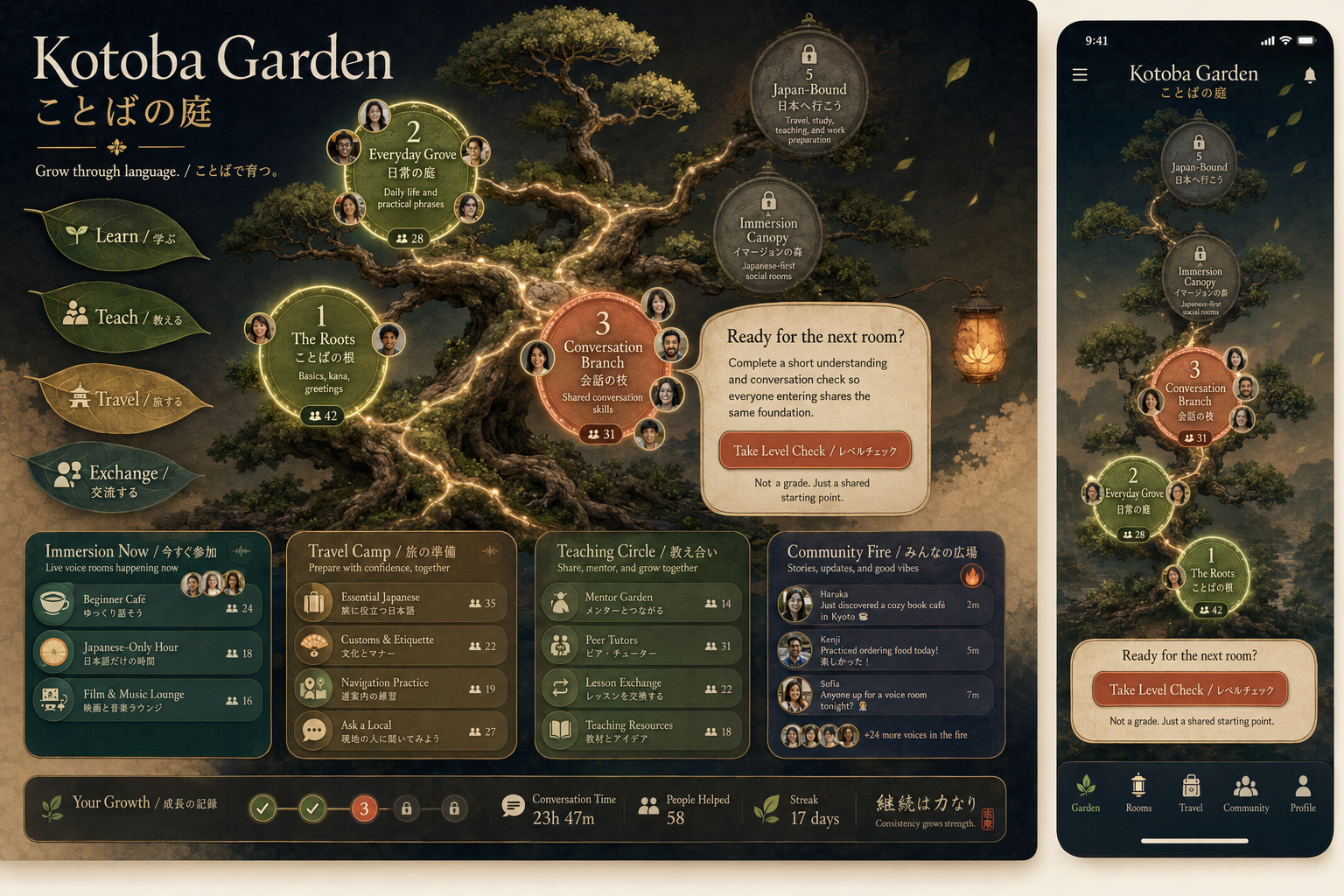
The first visual concept is Kotoba Garden (ことばの庭), The Garden of Words.
It is Japanese-first because learning Japanese is another personal goal of mine.
Inside that concept, someone could grow through spaces like:
The Roots: basic foundations, kana, greetings.
Everyday Grove: practical everyday language.
Conversation Branch: shared conversational skills.
Immersion Canopy: Japanese-first social spaces.
Japan-Bound: practical preparation for travel, study, teaching, or work.
But Japanese isn’t supposed to be the only tree.
The larger framework could include Korean.
Spanish.
ASL.
And eventually other spoken and signed languages.
And this part is extremely important to me:
Those trees should NOT just be the Japanese tree with different vocabulary pasted onto it.
Every language exists inside a culture.
Each tree should be developed with the people who speak, sign, teach, and LIVE that language.
Culture Is Not an Optional Lesson
This is another place where I think traditional language-learning tools can become too shallow.
You cannot separate language from the people who use it.
Words have context.
Tone has context.
Humor has context.
Etiquette has context.
Regional differences matter.
History matters.
Culture matters.
A sentence can be grammatically correct and still be completely inappropriate for a particular situation.
So the eLearning Tree is meant to connect language with culture, history, etiquette, media, regional differences, and everyday life.
That’s where things like music, film, games, storytelling, radio, and community media become incredibly useful.
Imagine learning through an interview.
A song.
A movie discussion.
A cultural event.
A game night.
A radio program.
Now the language is alive.
The Game Is Cooperation
There is another piece of this that I absolutely love.
I originally described the concept as:
“A game, but also a chat platform to learn languages.”
Then Kris made the idea better by suggesting something simple:
Why not reward people for learning AND for helping other people learn?
THAT clicked.
Because why should progress only measure how much you personally accumulated?
A fluent speaker helping a beginner should matter.
A beginner being brave enough to attempt a conversation should matter.
Someone sharing a lesson should matter.
Mentoring someone should matter.
Learning something and then helping the next person understand it should matter.
The platform could recognize conversations, rooms completed, lessons shared, and people helped.
That’s the game.
We grow by helping the garden grow.
And THAT is the kind of gamification I care about.
Not:
“Log in every day or your cartoon owl will emotionally blackmail you.”
😂
I want participation to mean something.
The Community Is Part of the Lesson
A language app can teach you vocabulary.
But a vocabulary list cannot become your friend.
It cannot laugh when you finally nail the phrase you’ve been practicing for two weeks.
It cannot explain why people actually say something differently than the textbook taught it.
It cannot tell you:
“Technically that’s correct, but nobody around here talks like that.”
People can.
Community can.
The eLearning Tree is designed around language-specific spaces where people could practice through conversations, cultural media, events, projects, mentoring, tutoring, and study groups.
The goal isn’t perfection BEFORE participation.
Participation is how people learn.
That sentence matters enormously to me.
Accessibility Has to Be Built Into Learning
And if I’m building a language community, it needs to recognize that people do not all learn or communicate the same way.
Some people need captions.
Some need transcripts.
Some process spoken language more slowly.
Some need repetition.
Some communicate more comfortably through text than voice.
Some need more time before answering.
Some people understand the material perfectly and still experience enormous anxiety speaking in front of other people.
So the platform concept includes multiple ways to participate: text, audio, captioned video, transcripts, adjustable pacing, pronunciation support, voice, video, chat, and asynchronous communication.
I even like the idea of the platform recognizing that people’s ENERGY changes.
High-energy day?
Maybe you join a live conversation.
Low-energy day?
Maybe today is vocabulary, listening, or watching something cultural.
You missed yesterday?
Fine.
The garden waits for you.
Learning shouldn’t punish somebody for being human.
AI Should Be a Bridge, Not the Culture
Of course AI can help.
It could explain something in another way.
Generate practice activities.
Help with pronunciation.
Recommend a room.
Assist with translation.
Help make content accessible.
But AI should not replace the human beings behind the language.
It shouldn’t become the authority on somebody else’s culture.
The eLearning Tree concept makes that distinction intentionally:
AI is the bridge. It is not the culture.
That is exactly how I want to think about educational technology.
Technology should help people reach each other.
Not eliminate the need for each other.
The Turn-the-Page Book Is Another Experiment
I’m also working on a turn-the-page book.
Right now it is only in English.
But I want to translate it into other languages so people can have FUN learning through the same story.
Because storytelling creates context.
Imagine reading a story in English first.
You know the character.
You know the scene.
You know what’s happening.
Then you encounter that same story in another language.
Now you’re not staring at a random vocabulary word floating alone on a screen.
The image gives you information.
The character gives you information.
The action gives you information.
The sentence gives you information.
The story gives you information.
And eventually your brain goes:
WAIT. I KNOW WHAT THAT MEANS.
That little click is what I want.
Because language is easier to remember when it has somewhere to live.
And This Is Only One Part of What I’m Trying to Do
The eLearning Tree is one of the closest ways I can apply this philosophy using my community technology right now.
But it is not the entire vision.
The eLearning Tree is specifically about languages.
The larger idea is about learning itself.
I want to explore what happens when we deliberately combine:
Games.
Stories.
Radio.
Books.
Interactive worlds.
Community technology.
Artificial intelligence.
Music.
Film.
Culture.
Play.
Rewards.
Exploration.
And curiosity.
Maybe another project eventually makes somebody curious about science the way Parasite Eve did for me.
Maybe a game teaches history because knowing history helps you unlock something.
Maybe a radio program introduces someone to another culture.
Maybe a story helps somebody understand another language.
Maybe a community gives somebody the courage to actually SPEAK that language for the first time.
These don’t have to be the same platform.
They can be different experiments built around the same philosophy.
I Want Technology That Creates Questions
Technology companies spend enormous amounts of effort trying to give us answers.
I want answers too.
But I also want technology that makes us ask better QUESTIONS.
Imagine finishing a game and thinking:
“Was that scientifically possible?”
Imagine hearing a song and wondering:
“What language is that?”
Imagine watching a character and wondering:
“What culture did this story come from?”
Imagine encountering an unfamiliar word and thinking:
“I’ve never heard it used that way. Where did that usage come from?”
That is where learning begins.
With a question.
Maybe Education Doesn’t Need More Memorization
Maybe we have spent too much time asking:
“How much information can this person remember?”
And not enough asking:
“Can this person CONNECT information?”
Can they take one thing and relate it to another?
Can they recognize a pattern?
Can they question the pattern?
Can they recognize when a comparison stops working?
Can they find context?
Can they research something unfamiliar?
Can they change their mind?
Can they take what they know and apply it to something they have never seen before?
Because that is what we’re going to need.
The world changes too quickly for education to simply hand someone a static collection of answers and declare the job finished.
The most valuable thing education can give someone may be the ability to keep educating themselves.
I Don’t Want People to Graduate From Curiosity
There is no:
CONGRATULATIONS. YOU HAVE COMPLETED KNOWLEDGE.
You don’t graduate from learning.
At least you shouldn’t.
The universe is much larger than the curriculum.
So yes, lately I have been disappointed.
Confused.
Sometimes genuinely appalled.
But I don’t want that frustration to end with:
“Education is terrible.”
I want it to become:
“What can I build differently?”
Right now one answer is the eLearning Tree.
A cooperative language-learning game and chat community where people can learn, teach, travel, exchange, practice, make mistakes, help each other, experience culture, and actually USE the language they are learning. The larger design ultimately connects language learning with community, media, cultural exchange, accessibility, and real opportunities to participate.
Another answer is storytelling.
Another may be games.
Another may be radio.
Another may not exist yet.
That’s okay.
I’m still asking questions too.
Because when I think about what actually taught me to love learning, I don’t remember one perfect curriculum.
I remember curiosity.
A dog introduced me to Shakespeare.
A magic school bus made science an adventure.
Mega Man bribed me into memorizing World War II facts.
Parasite Eve made me investigate mitochondria and DNA.
Decades of K-dramas taught me that understanding a language is not the same thing as having a community where I feel comfortable speaking it.
And all of those experiences keep pointing me toward the same conclusion:
Learning changes when you WANT the answer.
So maybe we need to stop treating curiosity like a bonus feature of education.
Maybe curiosity is the engine.
Give people something worth wondering about.
Give them somewhere safe to ask questions.
Give them people to learn with.
Give them tools to explore.
Let them make connections.
Let them get something wrong.
Let them try again.
Let one question grow into another.
And another.
And another.
That is the kind of technology I want to build.
Not technology that tells people they have finished learning.
Technology that leaves them thinking:
“Huh…I wonder why.”
And gives them somewhere to go next.
Keep asking questions.
Keep making connections.
Keep learning.
And when the system stops encouraging curiosity, build something that does.
Jessika Darkstar
Chief Technology Officer (CTO) at Darkstar Multimedia
Station Director at Dark Star Radio
Doctoral Candidate
Embodied Systems Design, Creative Technology & Transdisciplinary Innovation
Playing Lady Desire: Finding My Voice
Playing Lady Desire: Finding My Voice Lady Desire was supposed to be a wrestling character. She became a part of me that I needed permission to explore. When I step into Lady Desire, I am not trying to become a completely different person. I am taking emotions, instincts, and pieces [...]| Play | Cover | Release Label |
Track Title Track Authors |
|---|